









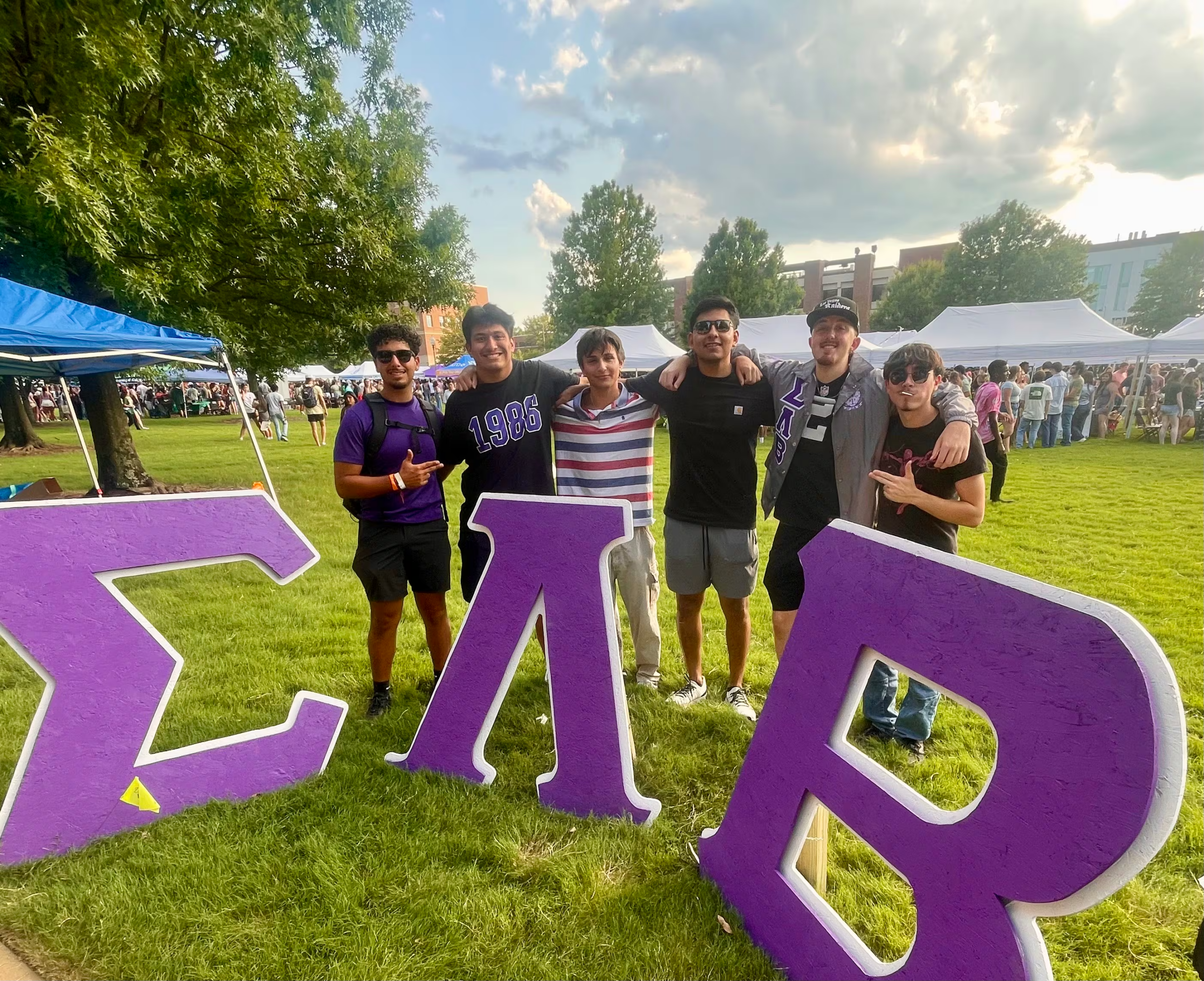
As the October sky faded to black, Kevin Ponce and his fraternity brothers practiced their moves behind a busted piñata on the campus green.
The lights strobed on and off, signaling the start of the annual stroll off – and the boys’ big debut. It would be the first time a Latino fraternity participated in the tradition on the University of Alabama at Birmingham’s campus, and the group was going to bring an old-school Rick James routine into the mix.
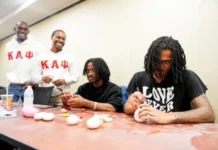
Kevin Ponce (far left) and other members of the Sigma Lambda Beta fraternity recruit members at a welcome event at the University of Alabama at Birmingham on Aug. 24, 2025. Rebecca Griesbach/AL.com
Ponce’s organization, a chapter of Sigma Lambda Beta, is the college’s first Latino-founded fraternity, and the only active one in Alabama.
As advocates work to boost the college-going and graduation rates of Hispanic students, social organizations are important, experts say.
“Having that circle makes college life more meaningful,” he said. “We’re going through the same struggles. We’re dealing with the same things that are going on in the world.”
Leveling the field
Ponce grew up in Carbon Hill, a rural area north of Birmingham, where his family was one of few Latino households in town. And his classmates made sure he knew it.
“I would be called racial slurs, and I’m pretty sure my siblings did, too,” he said. “It got to a point where some of my teachers had to gather all the students up and tell them that racism is not allowed.”
“It really did bring us down, and it almost made us feel like we didn’t deserve to be here or that we shouldn’t strive to do more.”
All Ponce knew was that he wanted to help out his parents, who came to the country from a small town in Michoacán, Mexico and ran a local restaurant, 3 Amigos. He was good at math and liked solving problems, and thought he might become a mechanic. College hadn’t crossed his mind.
Latino males are “vanishing” from higher education, research shows. Many are faced with economic and cultural pressures that may prevent them from fully participating in campus life, experts say.
“I feel like that’s where a lot of the Latino guys, after high school, don’t go for further education because they want to go ahead and start going to the workforce and helping their family,” Ponce said.